

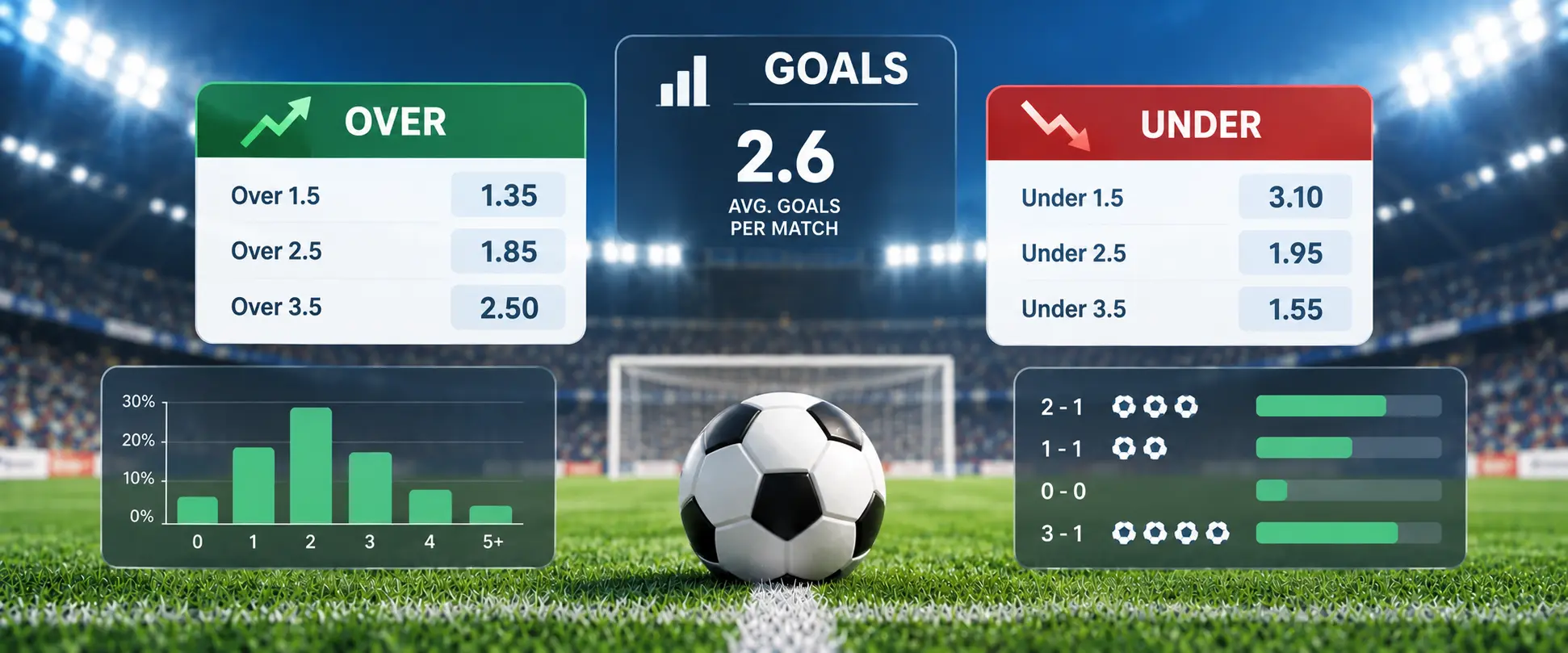
Most people pick a goals line by feel. “This one looks like an over 2.5 game.” Sometimes the feeling is right. But a feeling is not a price.
There is a simpler way. Start with one question: how many goals do we expect? The line comes after the answer. This guide shows what each over/under line means, how to turn an estimate into a probability and how to tell if the odds are worth taking.
What the lines mean
An over/under bet is a bet on the total number of goals in the match. Both teams count. The half-goal makes sure there is never a tie with the line.
| Line | Over wins if | Under wins if |
|---|---|---|
| 1.5 | 2 or more goals | 0 or 1 goal |
| 2.5 | 3 or more goals | 0, 1 or 2 goals |
| 3.5 | 4 or more goals | 0 to 3 goals |
Each line is a different claim. Over 1.5 says “the match will not be dead”. Over 3.5 says “this will be open and loud”. The higher the line, the lower the chance and the higher the odds.
Start with expected goals
Expected total goals is your estimate of the average number of goals in this match. If you could play it many times, that is the average you would see. It is not a prediction of one result. It is a number you can compare with a price.
To estimate it you look at how often each side scores and concedes, who is missing, and the style of play. Our guide on how professional bettors analyze matches covers these inputs, and the beginner guide to accurate football predictions explains the basic goal statistics.
From expected goals to a probability
A common shortcut is the Poisson distribution. It is a formula that turns an average into the chance of exactly 0, 1, 2, 3 goals and so on. It is a simplification: real matches have more surprises than the formula expects. But as a sanity check it works well.
The table below uses three hypothetical matches. The expected totals are made up. They only show how the probabilities move. The odds are fair odds, without the bookmaker’s margin.
| Expected goals | Over 1.5 | Over 2.5 | Over 3.5 |
|---|---|---|---|
| 2.2 (cautious match) | 64.5% odds 1.55 | 37.7% odds 2.65 | 18.1% odds 5.54 |
| 2.7 (average match) | 75.1% odds 1.33 | 50.6% odds 1.97 | 28.6% odds 3.50 |
| 3.2 (open match) | 82.9% odds 1.21 | 62.0% odds 1.61 | 39.7% odds 2.52 |
Fair odds are 1 divided by the probability. For an average match with 2.7 expected goals, over 2.5 has a 50.6% chance: 1 / 0.506 = 1.97. If a bookmaker offers 2.10, the price is better than your estimate. If it offers 1.80, it is worse.
Notice how much one idea moves the numbers. Half a goal more or less changes the chance of over 2.5 by more than ten points. That is why the estimate matters more than the line.
Real prices include a margin, so they will always be a little lower than fair odds. Our guide to how bookmakers set odds explains how to see it.
How to choose the line
Once you have an estimate, the choice is about where your view is strongest and where the price is fair.
- Over 1.5: the safest of the three, and the lowest odds. It fits when you expect goals but the price on over 2.5 is not good enough. Short odds need a very high win rate.
- Over/under 2.5: the main line and the most balanced. The market is liquid, so the margin is usually lowest here. Good when your estimate sits clearly above or below 2.5.
- Over 3.5: a high-odds line for matches you expect to be open. It loses most of the time, so it only makes sense when the price is clearly above your fair odds.
- Under 2.5: for matches with a cautious style, a lot at stake or key attackers missing. Remember that one early goal can change the whole bet.
If your estimate falls right on a line, the whole-goal lines such as 2.0 or 3.0 and quarter lines such as 2.25 let you split the stake or get a refund on the exact number. They are explained in our Asian goal line guide.
Want ready picks to compare with your own estimates? Our Pro subscription gives you several every day.
Common mistakes
- Choosing the line before the estimate. Decide how many goals you expect first. Then see which line, if any, offers a good price.
- Assuming high-scoring teams always mean over. One side can score a lot and still play in matches that end 1-0. Look at both teams and the match itself.
- Ignoring the margin. A line can feel right and still be priced below fair odds. If it is, skip it.
- Treating Poisson as truth. It is a rough tool. Use it to check your thinking, not to replace it.
- Chasing goals after a quiet week. Results of a few matches say little. Keep the same stake and the same method.
The bottom line
An over/under line is only a way to express a view about goals. Estimate the number first, turn it into a probability, then compare it with the price. If the odds are not above your fair odds, there is no bet.
Stake the same amount each time and keep a record. Our bankroll management guide shows how.
No betting market is a sure thing. Bet responsibly. 18+ only.


