

Football has three outcomes. That makes many bets feel like a coin flip with a trapdoor. Double chance and draw no bet remove the trapdoor, but at a price.
Both markets either protect you from the draw or cover more results. Both pay less than a plain win bet. This guide shows how each one works, how the price is built and when each one makes sense.
What double chance means
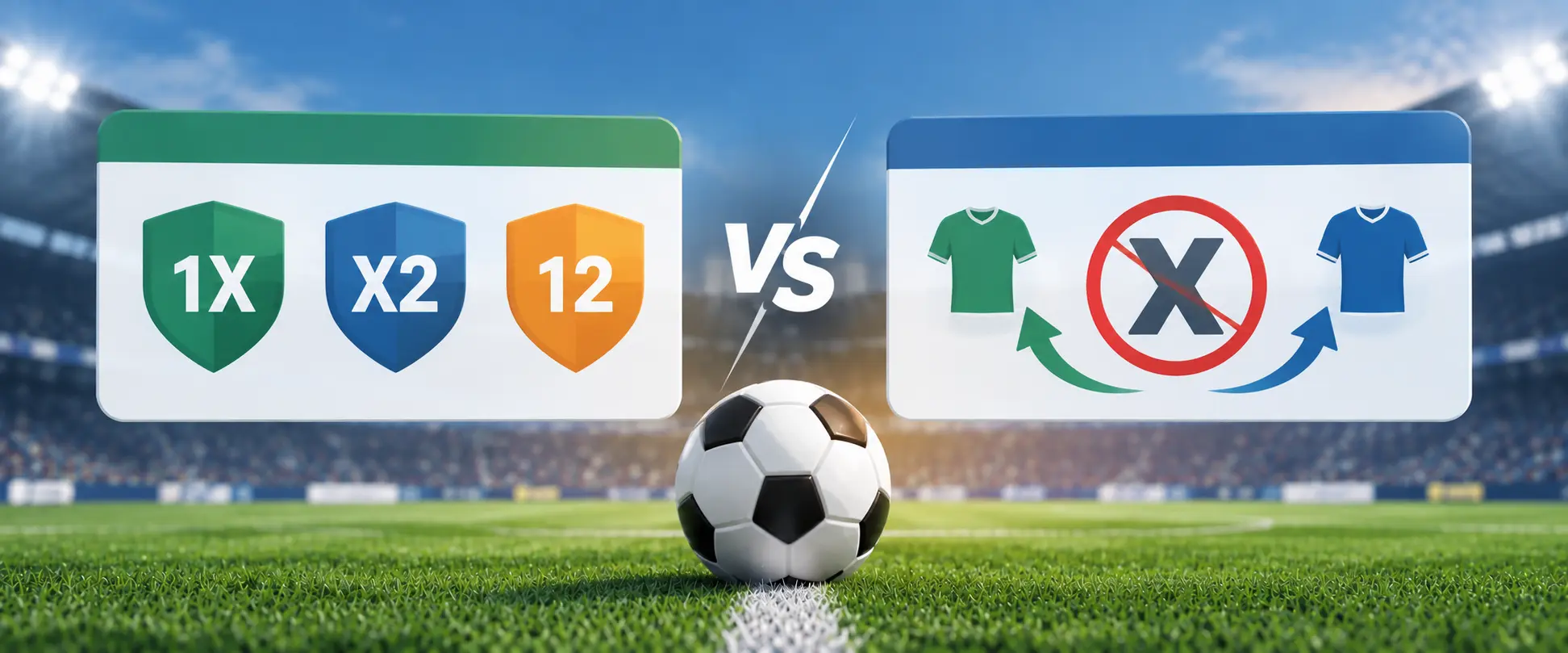
Double chance lets one bet win on two of the three results. Bookmakers offer three versions:
| Bet | Code | Wins if | Loses if |
|---|---|---|---|
| Home or draw | 1X | Home win or draw | Away win |
| Away or draw | X2 | Away win or draw | Home win |
| Home or away | 12 | Either team wins | Draw |
1X and X2 are the common ones. 12 is for matches where you expect a winner but cannot say which. On a single bet there is no refund: if the result is not covered, you lose the stake.
What draw no bet means
Draw no bet (DNB) removes the draw instead. You pick one team. If it wins, you win. If the match is drawn, your stake comes back. If it loses, you lose.
| Result | What happens to a draw no bet on the home team |
|---|---|
| Home win | The bet wins |
| Draw | Stake returned |
| Away win | The bet loses |
DNB works exactly like an Asian handicap of 0. If you want to go further with this family of bets, read our Asian handicap guide.
What the extra cover costs
The more results a bet covers, the lower its odds. The market gives nothing away for free. Here is a hypothetical match. The probabilities are made up and only show the method. The odds are fair odds, without the bookmaker’s margin.
| Bet | Chance it wins | Chance of a refund | Fair odds |
|---|---|---|---|
| Home win | 50% | – | 2.00 |
| Home or draw (1X) | 77% | – | 1.30 |
| Home draw no bet | 50% | 27% | 1.46 |
Fair odds are 1 divided by the probability. For double chance: 1 / 0.77 = 1.30. For DNB, remove the draw first: 0.50 / (0.50 + 0.23) = 68.5%, so the fair odds are about 1.46. Real prices are lower because of the bookmaker’s margin. Our guide to how bookmakers set odds explains how.
So neither bet is safer in the way many people think. You trade a smaller payout for a bigger chance. The only question is whether your own estimate is better than the price.
When each one makes sense
- 1X: a strong home side where the draw is a real danger but a defeat looks unlikely.
- X2: an away team you rate, in a match where winning will be hard.
- 12: two teams that both play to win, where a draw looks unlikely.
- DNB: you like one team, you fear the draw and the double chance price is too short.
Judging which result is unlikely takes analysis. Our match analysis guide shows where to start.
Prefer a steady style with lower odds? Our Smart subscription is built around that idea.
Common mistakes
- Treating low odds as low risk. At odds of 1.30 you need to win about 77 of every 100 bets just to break even. One loss wipes out more than three wins.
- Comparing only one bookmaker. The same market carries a different margin at every bookmaker. Compare prices.
- Raising the stake because the bet feels safe. A bet that feels safe loses just like any other.
- Using the cover on every match. If you have no view of your own, there is no bet.
The bottom line
Treat double chance and draw no bet as tools, not shortcuts. Less variance does not mean free profit. Use a flat stake and track every bet. Our bankroll management guide shows how.
Want to practise on real matches first? Open today’s free predictions and compare the prices with your own estimates.
No betting market is a sure thing. Bet responsibly. 18+ only.


