

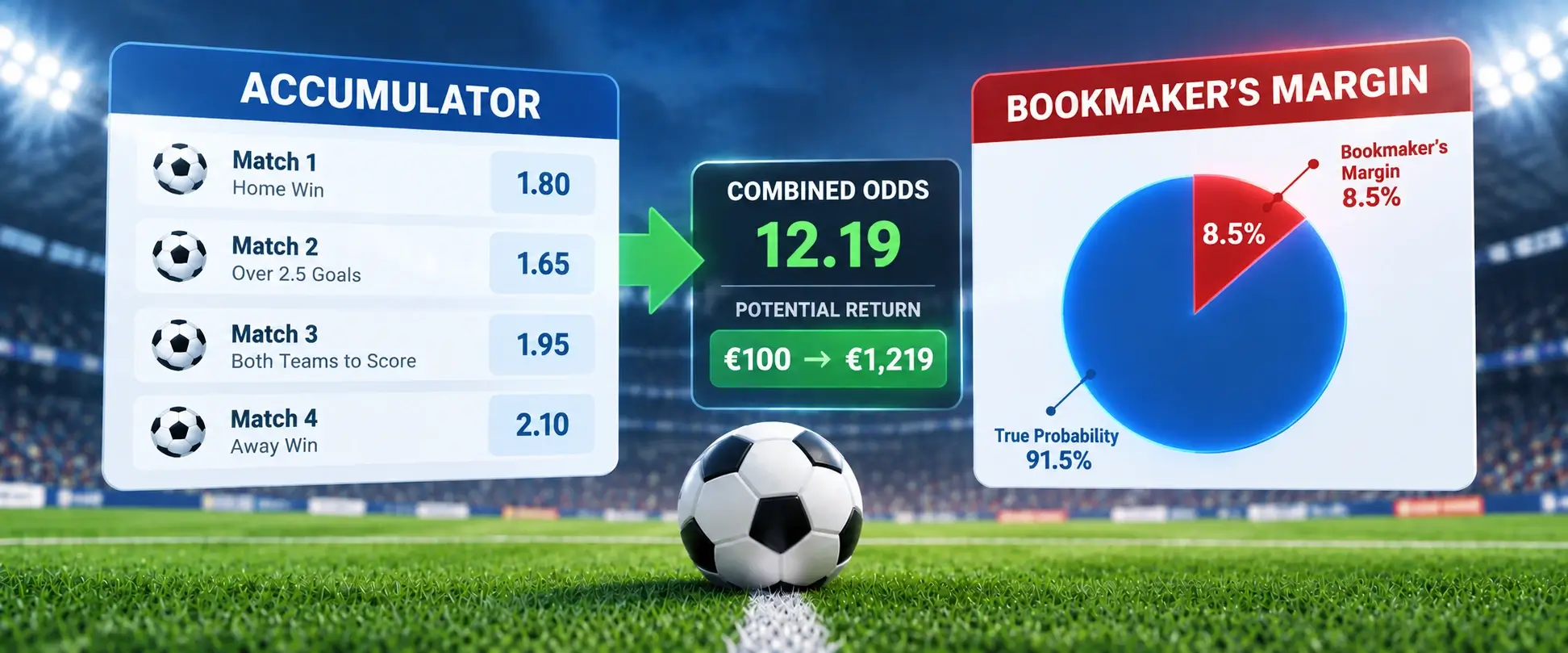
An accumulator looks generous. Six selections at modest odds multiply into a price like 47.00. A small stake, a big number. It is easy to see why people like them.
What the big number hides is the bookmaker’s margin. It sits inside every single price. When you multiply the prices, you multiply the margin too. This guide shows how much that costs, with numbers you can check yourself.
Where the margin comes from
A bookmaker does not pay you the fair price of an outcome. It pays a little less. That gap is the margin, and it is how the bookmaker earns money on every market. Our guide to how bookmakers set odds shows how to measure it.
On a single bet the cut is small and easy to ignore. On an accumulator, each selection takes its own cut. The returns are multiplied one after another, so the losses are too.
A worked example
To keep the numbers clean, take an event with a true chance of exactly 50%. Its fair odds would be 2.00. Now let the bookmaker pay 95% of the fair price. The odds become 1.90.
On one bet of 100, you get back 95 on average. The margin costs you 5. Now chain several of these events together. Every selection has the same 50% chance and the same 1.90 price. The selections are independent.
| Selections | Accumulator odds | Fair odds | Chance of winning | Average return per 100 | Average loss per 100 |
|---|---|---|---|---|---|
| 1 | 1.90 | 2.00 | 50% | 95.0 | 5.0 |
| 2 | 3.61 | 4.00 | 25% | 90.2 | 9.8 |
| 3 | 6.86 | 8.00 | 12.5% | 85.7 | 14.3 |
| 4 | 13.03 | 16.00 | 6.25% | 81.5 | 18.5 |
| 5 | 24.76 | 32.00 | 3.1% | 77.4 | 22.6 |
| 6 | 47.05 | 64.00 | 1.6% | 73.5 | 26.5 |
Take the four-fold. It pays 13.03 times your stake and wins once in 16 attempts on average. A fair price for something that wins once in 16 is 16.00. The distance between 13.03 and 16.00 is the margin, and it is now more than 18% of the fair price.
The average return is the stake multiplied by 0.95 for each selection. For four selections that is 0.95 × 0.95 × 0.95 × 0.95 = 0.815. So 100 returns 81.5 on average. These are averages over many bets. One accumulator either pays or it does not.
Singles against one accumulator
Say you have 100 to spend on six selections. You can place six singles of about 16.67 each. Or you can put all 100 on a six-fold.
| Way to bet 100 | Chance of a payout | Average loss |
|---|---|---|
| Six singles of 16.67 | Each single wins 50% of the time | 5.0 |
| One six-fold | 1.6% | 26.5 |
The selections are the same. The margin is not. The six-fold costs about five times more on average, and it pays out rarely. If it does hit, it pays 4,705 on a 100 stake.
What if the margin is different?
Margins vary between markets and bookmakers. The table shows the average return per 100 for three payout levels. The 92%, 95% and 97% figures are only for illustration, not a statement about any bookmaker.
| Bookmaker pays | 1 selection | 2 selections | 4 selections | 6 selections |
|---|---|---|---|---|
| 97% of fair price | 97.0 | 94.1 | 88.5 | 83.3 |
| 95% of fair price | 95.0 | 90.2 | 81.5 | 73.5 |
| 92% of fair price | 92.0 | 84.6 | 71.6 | 60.6 |
A thin margin helps a lot, because it is raised to a power. The lower the payout and the more selections, the faster the return falls. So shop for the best price on each leg, and be careful with markets that have fat margins. They hurt more inside an accumulator.
The same maths works both ways
Compounding does not only work against you. If a price really is 5% better than the true chance, each selection returns 1.05 on average. Over six selections that is 1.05 to the power of six, about 1.34. In theory the accumulator multiplies a real edge too.
The catch is the word “really”. Your estimates have errors, and those errors compound as well. If each estimate is only a few points too optimistic, the six-fold turns into the 73.5 row above. That is why knowing whether a price is good matters more than the number of selections. We cover how to do it in our guide to soccer betting strategies.
One more limit. This example assumes the selections are independent. Combining outcomes from the same match is a different calculation and bookmakers price it differently.
If you still want to play accumulators
Plenty of people enjoy them, and that is fine. Just treat them as entertainment with a known price, not as a shortcut.
- Keep the stake small. A six-fold wins rarely. Decide the amount before you build it, and see our bankroll management guide for how to size it.
- Use fewer selections. Each extra leg adds margin and cuts the chance of winning. Two or three is a very different bet from eight.
- Pick the best price for every leg. A few points on each selection add up across the whole bet.
- Consider a system bet. A Trixie or Yankee pays something even if one leg fails. Our betting system calculator shows the number of bets and the return for each case.
- Just want some random fun? The random accumulator generator builds one for you. Keep that stake small too.
If you like higher odds, our Master plan is built around them: at least two AI-powered picks a day, each at odds of 2.50 or higher.
The bottom line
An accumulator does not change the bet. It stacks the same margin on top of itself. One selection at a 5% margin costs 5% on average. Six cost about 26%.
That does not make accumulators forbidden. It makes them expensive, so use them on purpose, with a small stake and a price you have checked.
No betting market is a sure thing. Bet responsibly. 18+ only.


